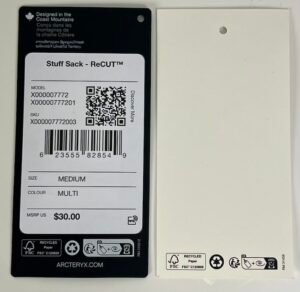
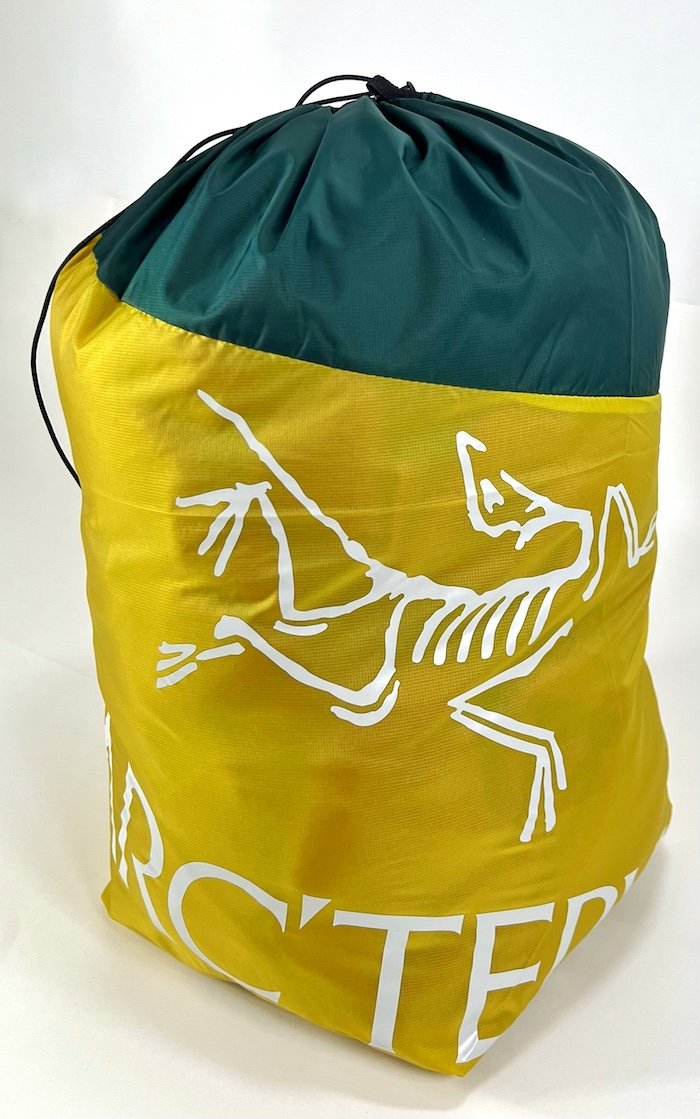
The Arc'teryx Stuff Sack costs $30 and ships in a unique patchwork colorway that no other unit will match. Arc'teryx builds it from leftover shell fabrics at the ARC'ONE facility in New Westminster, BC, in sizes S and M. Model number X000007772, Fair Trade Certified production.
Arc'teryx Stuff Sack ReCUT Materials and Construction
Arc'teryx assembles every unit from whatever factory remnants are available on the production line. That could mean N40r-X nylon from a $475 Beta SL run or Tyono 30 from a $199 Squamish Hoody batch. The materials keep retaining their original performance. The OR-TEX remnants stay waterproof, and the DWR-treated nylon sheds water.
Construction quality meets Arc'teryx's standards. Same bar tacks, same seam finishing. Performance varies across the patchwork panels because each scrap came from a different garment, but nothing about the stitching feels like a B-grade product.
One sack might combine three different shell fabrics in black, blue, and green. Another might land almost entirely in one color. You don't get to choose, and Arc'teryx doesn't take requests.
How Do the S and M Sizes Compare?
Arc'teryx doesn't publish exact volume or dimensions for ReCUT products. Materials and construction vary unit to unit, so standardized measurements don't apply.
Small handles a lightweight Nodin Jacket or base layer without much room to spare. Medium fits a puffy or sleeping bag liner with room to cinch down.
Most jackets ship with their own stuff sack, but those only fit that specific garment. The Arc'teryx Stuff Sack ReCUT works as a standalone compression sack for whatever you throw at it.
I ordered the M. At just over 6 feet and 165 pounds, I need room for larger base layers that won't compress into a small sack. Two midweight fleeces or a dozen rolled t-shirts fit without fighting the closure.
$30 Stuff Sack vs. Sea to Summit and Granite Gear
The Arc'teryx Stuff Sack ReCUT costs 2-3x as much as comparable sacks but uses tougher materials. Sea to Summit sells Ultra-Sil stuff sacks for $12-18 in 30D silnylon at 12-30 grams. Granite Gear's Air Bags run $10-15 with published specs and multiple sizes, XS through XL.
The price makes more sense when you look at the fabric. These remnants outperform a $12 silnylon sack by a wide margin in abrasion resistance and tear strength. Fair Trade Certified production means workers receive direct payments beyond standard wages, and each sack diverts factory scraps from landfill.
Silnylon does have one advantage: it's lighter and more packable when empty. A Sea to Summit Ultra-Sil disappears into a pocket, while the ReCUT holds its shape because the shell fabrics are stiffer.
Arc'teryx doesn't publish the weight either. That's a real gap for anyone who builds pack lists down to the ounce. You're buying blind on the one spec ultralight hikers care about most.
Arc'teryx Stuff Sack ReCUT for Travel Packing
The compression design cinches flat when half full, shaping more like a rigid organizer than a floppy sack. That works well inside a Granville 16 or any daypack where dead space costs you capacity.
I'm using it alongside the Shoe Bag ReCUT and an Index Gear Organizer for electronics. Together, the two ReCUT pieces cost $80 for clothing and footwear isolation, which is steep for stuff sacks.
Every fabric in this sack survived Arc'teryx's shell production so that a suitcase won't kill them. If your packing strategy depends on knowing volumes to the half-liter, Sea to Summit wins. The Arc'teryx Stuff Sack ReCUT trades precision for material quality and a one-of-a-kind colorway that resells above retail when batches sell out.